Are Oregon and Washington State in danger of an epic tsunami disaster?

All Pacific-coasters should be fearful of what’s referred to as the Cascadia subduction zone. It is a 600-mile-long offshore earthquake fault that runs from northern California to southern British Columbia.

And that fault has a serious tale to tell. Geologists have found sand deposits up and down the Pacific coast along this zone, the result of a tsunami a little over 300 years ago.

We agree, three hundred years is a long time and that bit of trivia in and of itself may not seem threatening, but pair it with what scientists now know about earthquake patterns, and the Pacific Northwest Coasters should be trembling in fear – or at least preparing for an impending disaster in the very near future.

“I think all subduction zones are guilty until proven otherwise,” Dr. Kerry Sieh told National Geographic in their February 2012 issue. Sieh, director of the Earth Observatory at Singapore’s Nanyang Technological University, is one of the world’s leading paleoseismologist. He spends his days obsessing over geologic records for evidence of ancient earthquakes and tsunamis, and identifies what he calls, “supercycles” or clusters of big earthquakes that occur at regular and predictable intervals.

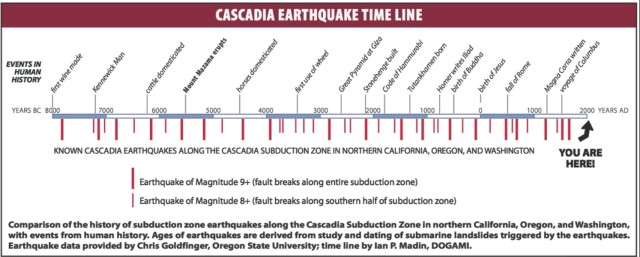
While the most recent tsunami may have hit that region more than 300 years ago, recent evidence from seafloor sediment cores suggests that about 40 earthquakes have occurred along the Cascadia fault zone over the past 10,000 years, with an alarming average of one every 250 years; although some researchers estimate the recurrence interval at 500 years.

Scientists may not be in total agreement on the recurrence interval, but where there is a meeting of the minds is in their confidence that when the fault does rupture, the earthquake (or earthquakes) could be as large as the one that hit Japan in March just last year, and that the tsunami could reach the Oregon coast in 20 short minutes.

If that horrific event were to occur during prime summertime tourist season, it is expected to create widespread devastation and a massive numbers of casualties.

The most populated area of Washington State is Seattle, insulated on Puget Sound behind the Olympic Peninsula and likely harboring it from major harm. Alarmingly however, geologists are now discovering smaller, shallower cracks in the crust that extend under Puget Sound. They are unclear on how often those earthquakes occur but are suspecting the most recent occurred a thousand years ago. Those new-found cracks are especially disturbing in that a comparatively moderate tsunami starting off Seattle could be more damaging than a giant one off the main coast.

Washingtonians can hardly be in the dark with evacuation signs, information booklets and broadcast towers spotting their landscape. Even so, evacuation centers are rare and many residents do not have access to high ground – and would ultimately perish if such a disaster were to hit their coast. The smartest action to take is to prepare for the worst disaster – and do it now.

We are approaching the 1-year anniversary of the devastating tsunami that rocked Japan and the pacific rim. While countries affected by the massive disaster continue to struggle to recover, we can’t help but turn out thoughts closer to home and our own vulnerabilities to a similar fate.

Here is a list of a few link resources to help outline how you can start disaster planning for your coastal area for a tsunami-related event:

Southern California info:

Data backup – How good is YOURS? Questions about Online Backup

90% of businesses will experience a data loss within their first 5 years.

Ouch.

That’s called the school of hard-knocks. New businesses are so singularly focused on growth, that sometimes they overlook the insurance they need to maintain it in the event of a disaster. A significant data loss can derail any business, especially one clawing its way to more and more market share.

Regardless of whether it’s server backup or PC backup that is needed, an online backup solution is the confidence any company needs to keep ticking like an energizer bunny, no matter what mother nature or evil people throw their way.

Here are 5 questions to ask yourself about your company’s data backup program:

1. How do you know if you’re backing everything up? Because honestly, backup isn’t only files. It’s server settings, operating systems and databases too. Make sure these e on your online backup checklist as well.

2. Where is your back up? If you’re in a flood plain or earthquake zone, an off-site data backup solution is probably not a suggestion, it’s a requirement., unless you like running the odds. And even if you’re tight with the forces of nature, there’s thieves – who can be more pesky than a tornado when it comes to leaving a headache for you to clean up. Consider a complete online backup solution that will send fully encrypted data to a secure off-site storage facility, without burning discs or running to lock boxes, because that’s so old school.

3. So you say you’re backing up fine. Awesome. How practical will it be to perform a system restore of your data if you need to? Are you sure that you are protected from virus or software corruption? Software issues could potentially wreck your backup – and hence your system restore capabiliy. An online backup solution keeps your backup copy offsite, and a full system restore allows you to recover from different points in time. Say for example, the moment BEFORE that disgruntled employee uploaded a virus to your network that sent it spiraling out of control.

4. Are you protected from the ID-10-T problem? File recovery access is another feature you should be shopping for with your data backup plan. Restoring your whole business and system is great, but what if someone accidentally overwrote all your accounting files. Online backup makes it super easy to retrieve data — file by file or even a full system restore.

5. Are you on a set it and forget it program? Human error is the most common error. If your backups are the responsibility of an individual or department, you are leaving yourself vulnerable. An automatic data backup system is insurance for those forgetful ways…if you ever need a system restore, and sooner or later you probably will, you’ll be happy you took the simple steps to get started.

Simple steps to get started.